You didn't ask for reality, you asked for more teeth – The Dinosauroid
In a small museum in Dorchester there exists a very strange model of a man-like dinosaur with green skin and large yellow reptilian eyes. This isn’t a science fiction museum, this is the Dinosaur Museum, the only museum in the UK solely dedicated to Dinosaurs. The model, cast from fibreglass and filled with sand (Russell and Séguin, 1982), is one of the most unique things you can find in a scientific museum like this.
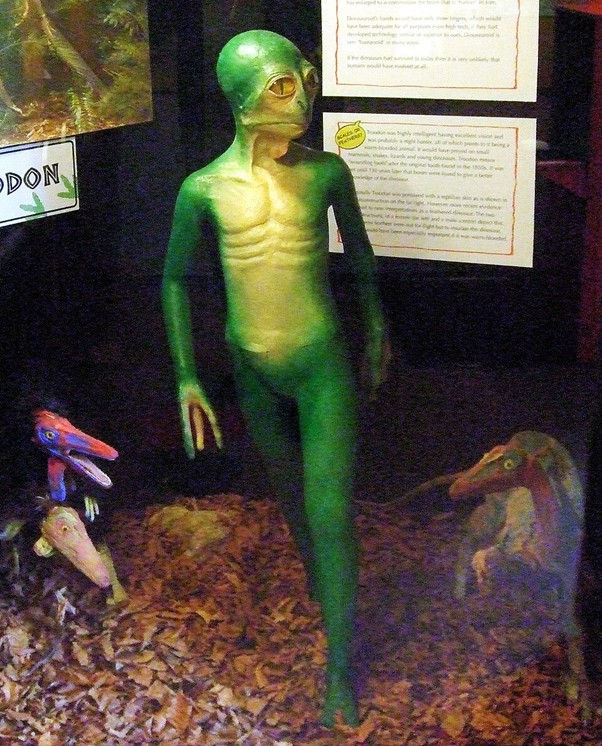
Figure 1: The creepy model of the Dinosauroid. (Wikimedia Commons, 2026).
The concept of a “dinosauroid” comes from Dale Russell in 1982, when he was the curator of vertebrate fossils at the National Museum of Canada. He theorised that, had the dinosaurs not gone extinct with the end Cretaceous extinction event, there’s a possibility that one of the smarter species may have evolved to fill the role that Humans take up today. The basis of this theory is the troodontids, specifically Stenonychosaurus. Now, this species is currently disputed as to whether it even exists, let alone if it could turn into a man-like creature, but at the time it was a full genus and so Dale went ahead with his idea of a “dinosaur man” (Russell and Séguin, 1982).

Figure 2: The head and neck of a model of the Stenonychosaurus. (Wikimedia Commons, 2026).
The troodontids are noted as being amongst the smartest of all dinosaur species, and Dale noted that over time, the brains and skulls of dinosaurs had been getting larger, and the troodontids had around six times more encephalization quotient (EQ, the relative brain weight when compared to other species with the same body weight) than other dinosaurs. Therefore, he proposed that if Stenonychosaurus had not gone extinct, it may have a brain and skull of similar size and proportion to modern man (Russell and Séguin, 1982).
Troodontids also had binocular vision, semi-manipulative fingers, and therefore able to grasp things to a degree. The dinosauroid, therefore, would also carry these traits, with three fingers, one of which would be partially-opposable, and a toothless beak. Young would be fed like modern birds, with regurgitated food as the feeding method, and a language much like bird calls (Russell and Séguin, 1982).

Figure 3: An illustration of the dinosauroid. (Wikimedia Commons, 2026).
Though he called this a “thought experiment”, he did work with sculptor and artist Ron Seguin to make a model both of Stenonychosaurus but also of the dinosauroid. Built from fibreglass and filled with sand for weight, the dinosaur model took seven months to make while the dinosauroid took half the time (Russell and Séguin, 1982).

Figure 4: A Top Trumps card for the dinosauroid, here using the original dinosaur’s name.
Perhaps unsurprisingly, the dinosauroid was not met with great enthusiasm. Some consider the dinosauroid too anthropomorphic, while Darren Naish argued that any sort of “evolved troodontid” would retain a more standard theropod layout of a long tail and horizontal posture, using its mouth to manipulate objects rather than with hands like humans do (Naish, 2006).
Regardless of its feasibility, a dinosauroid is a fun “what if” hypothetical of what a species might have been like if the dinosaurs were still around and if the rise of mammals had not occurred. We can never know for sure what might have happened, and if things had been different maybe I would be a dinosaur right now, typing this with my scaly hands. Alas, I am stuck as a mammal (for now) and the dinosauroid is just one fun thought experiment of a potential different timeline.
Berengar Needham is currently a student on the MSc Museum Studies programme at the University of Leicester.
References
Naish, D. (2006). Dinosauroids revisited. Darren Naish: Tetrapod Zoology.
Russell, D. A., Séguin, R. (1982). Reconstruction of the small Cretaceous theropod Stenonychosaurus inequalis and a hypothetical dinosauroid. Syllogeus. 37, pp. 1–43.


Comments