Good hunting on the main land of Europe – D-Day -1
Updated: Jun 6
On the evening of the 5th June 1944, the combined armies of the Allies prepared to undertake the largest seaborne landing in history (Beevor, 2009). Months, years of planning had been leading up to this moment. Nearly 160,000 fighting men (Ellis et al., 2004) were prepared to cross the English Channel in the early hours of the 6th to take on the formidable German Atlantic Sea Wall and prepare to liberate the continent from the iron grip of the Nazi eagle. Operation Overlord, as it is known, was originally planned for the 5th June but bad weather delayed it to the following day (Whitmarsh, 2009).
There’s a lot of museums that cover this topic in some way, which was the main inspiration to write these three pieces about this historic event. The D-Day Story, Army Flying Museum, Fleet Air Arm Museum, HMS Belfast, The Tank Museum, the list goes on just for English museums and all have amazing examples of original materiel or vehicles that took part in D-Day.

Figure 1: Assault routes of D-Day, by sea and air. (Wikimedia Commons).

Figure 2: An aerial photograph from The D-Day Story in Portsmouth showing landed gliders near Pegasus Bridge. (The D-Day Story, 2026).
However, we must start with the night before, when 1,200 aircraft (Beevor, 2009) took off from airfields all over Southern England to capture and hold key strategic locations and distract German divisions from the invasion beaches. Nearly 15,000 American airborne and glider-borne troops, mainly the 82nd and 101st Airborne Divisions (Ford and Zaloga, 2009), landed amongst locations such as Carentan and Sainte-Mère-Église while also capturing or contesting gun batteries and bridges to prevent German reinforcements (Warren, 1956).

Figure 3: General Dwight D. Eisenhower talking to American airborne troops on the day of the 5th June. (Wikimedia Commons).
British and Canadian paratroopers and glider-borne troops landed as part of Operation Tonga and Operation Mallard, near to the city of Caen which was the major British objective to capture as part of D-Day. Like the Americans, they were to capture or destroy several key bridges and occupy towns to distract and delay German reinforcements (Beevor, 2009). The Army Flying Museum in Hampshire always springs to mind when I think of glider operations, as they have an excellent display and example of an Airspeed Horsa glider, seen below.
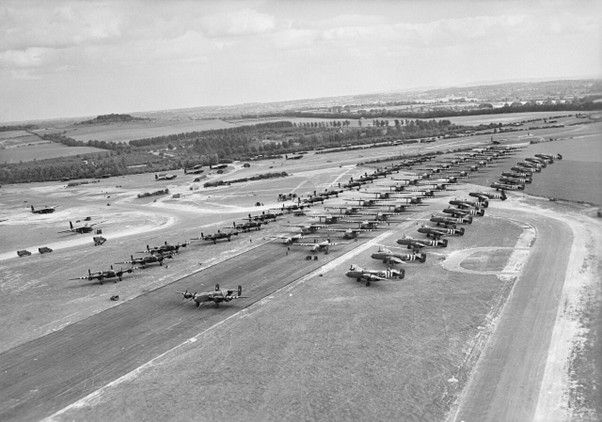
Figure 4: RAF Handley-Page Halifax bombers and Airspeed Horsa and Hamilcar gliders waiting for Commonwealth paratroopers and glider-borne troops. (Wikimedia Commons).

Figure 5: The Airspeed Horsa display in the Army Flying Museum. (Pinterest.com).
American landings were scattered for a variety of reasons, including German anti-aircraft fire (flak) as well as cloud cover, which was only magnified by the night drop. However, at 06:30 hours on the 6th, they were able to capture the town of Saint Martin-de-Varreville as well as destroy gun batteries around Sainte Marie-du-Mont. Due to their scattering, it took several days for the divisions to form up and begin the assault on Carentan on the 10th June. Other activities by the divisions including destroying and delaying German units along roads and other avenues (Warren, 1956). If you get the opportunity, the Menominee Range Historical Museum in Iron Mountain, Michigan, has an entire facility dedicated to American glider troops.

Figure 6: US paratroopers fighting German resistance at Sainte-Mère-Eglise. (US National Archives).

Figure 7: An American glider at the Menominee Range Historical Museum, Michigan.
The British and Canadian landings suffered a similar opening, with bad weather and pilot error resulting in a scattering of forces. However, they were able to reform quickly and move onto their objectives, including the famous assault on the Merville Gun Battery. The 6th Airborne Division (with the assistance of the 7th Parachute Battalion) was able to assault and capture the critical Orne River bridges (Harclerode, 2005), the only way off of Sword Beach, one of the British landing beaches for D-Day (Finkel, 2019). Failure to do so would have resulted in British forces remaining stuck on Sword at the mercy of German artillery and counter attack. After capturing it, the paratroopers and glider-borne held it against several German counter-attacks, including ones supported by tanks and armoured support (Buckingham, 2005). Eventually they were relieved in the late evening by the first elements of British troops arriving from the successful landing on Sword Beach (Gale, 1948). These bridges, now officially renamed to Pegasus and Horsa Bridge, have the nearby Memorial Pegasus dedicated to the battle and events around it, also featuring a replica glider.

Figure 8: The Caen Canal bridge captured by Commonwealth forces, seen here not longer after D-Day. (Wikimedia Commons).

Figure 9: The bridge today, having been moved due to being replaced by a modern bridge in the same spot. Also present is the sign and information about it from the Pegasus Memorial.
Now, the assault on the Merville Gun Battery is quite the different story. The 9th Parachute Battalion was tasked with taking and holding the battery to prevent its 150mm coastal guns firing on Sword Beach. The problem was that their landing was scattered, so instead of 600 men and heavy equipment, they had only 150 men with none (Ferguson, 1984). Still, they made the assault, and managed to take it with only 75 men remaining. They destroyed what guns they could, which they found to be WWI-era 75mm guns without the range to target Sword Beach some 9 miles away (Beevor, 2009), and then moved onto the village of Le Plein. Supported by commandos, they managed to liberate the village (Harclerode, 2005) and commandos occupied the Merville Battery, but were forced out by the Germans a day later (Saunders. 1959). The battery and grounds itself is now a museum, with a Douglas Dakota aircraft and all the bunkers open for viewing.

Figure 10: A paratrooper with a German prisoner-of-war taken from the battery. (Barber, 2026).

Figure 11: Sunrise over the battery museum, with the Douglas Dakota in the foreground. (Musee de la Batterie de Merville, 2026).
Over 2,200 bombers also played their part in preparing for the seaborne assault, attacking various targets across both the coast and further inland. Due to cloud cover, many bombers delayed releasing their payloads on the coast which prevented much of the German defences from being destroyed (Wilmot, 1997). Furthermore, the bombing of French cities (where German forces were thought to be stationed) caused widespread destruction (Valla, 2001) and civilian casualties (Roger and Rousseau, 1945). The Memorial de Caen covers this in detail, with replica bomb damaged streets and artefacts from the period. Lancasters and other bombers from the period can be seen in places such as the RAF Museum London, or RAF Hendon which I highly recommend.

Figure 12: The damage sustained to Vire as a result of Allied bombings prior to D-Day. (Wikimedia Commons).
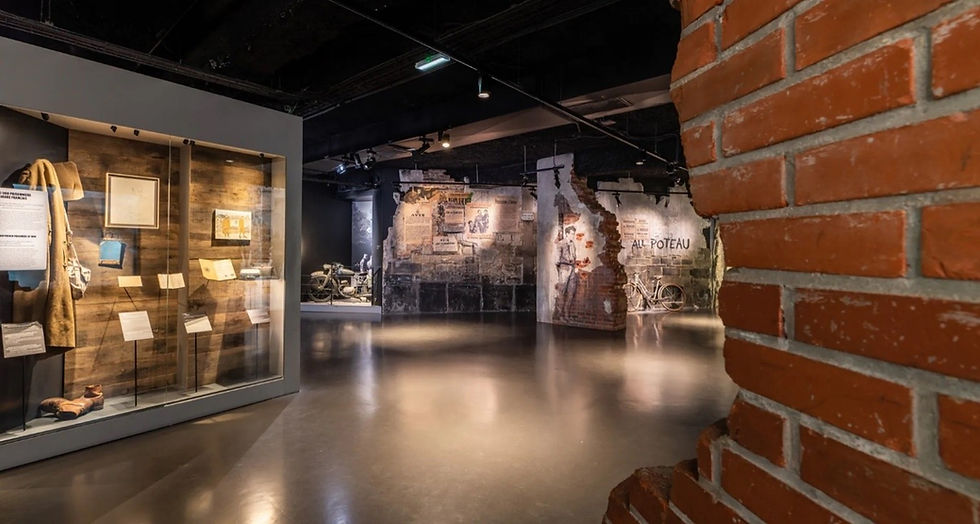
Figure 13: Part of the WWII exhibit in the Memorial de Caen. (Memorial de Caen, 2026).
We cannot forget the actions of the French Resistance, either, who participated in preparing for D-Day with orders from London. They sabotaged railway lines, damaged roads, and cutting telephone lines and electrical infrastructure (Douthit, 1988). This disruption of German logistics undoubtedly delayed reinforcements from reaching Normandy and hampered co-ordination during the airborne landings and seaborne assault. In Paris, there’s the Musee De La Resistance Nationale, part of several larger museums, which covers all of the French Resistance activities during the German occupation, not just during D-Day.

Figure 14: French Resistance members with 82nd Airborne troops. (Wikimedia Commons).

Figure 15: An example of inside the Paris museum, with propaganda posters and a large French flag.
Finally, we will turn to the sea and that massive collection of warships and landing craft waiting to land on five Normandy beaches, code-named Sword, Juno, Omaha, Gold, and Utah. The combined navies of the Allies were ready to support the landings, both during the crossing and before the assault, and at midnight the fleet bombarded German coastal positions and cleared sea mines in preparation for the first wave of landings to commence at 06:30 hours (Ford and Zaloga, 2009).

Figure 16: The beaches and positions of supporting warships on the 6th June. (Wikimedia Commons).
With as much preparation as possible, at 06:30 hours the first of the landing craft were sent to Utah Beach, one of the two American beaches. D-Day had come and zero-hour had been called. It was now down to the brave soldiers of the Allied forces to fight the most important battle of the Western Front and see if the largest seaborne assault in history would be a success…
Berengar Needham is currently a student on the MSc Museum Studies programme at the University of Leicester. This article is Part 1 of 3 - stay tuned for Part 2 tomorrow!
References
Barber, N. (2026). Pte Durston with a German Prisoner, June 1944. paradata.org.uk. Available at: https://paradata.org.uk/archive/non-premium/photos/photos-batch-5/4527416-pte-durston-with-a-german-prisoner-june-1944?entity=4663557&entity-title=Merville%20Battery
Beevor, A. (2009). D-Day: The Battle for Normandy. New York; Toronto: Viking. ISBN 978-0-670-02119-2.
Buckingham, W. F. (2005). D-Day: The First 72 Hours. Tempus Publishing. ISBN 9780752428420.
Douthit, H. (1988). The Use and Effectiveness of Sabotage as a Means of Unconventional Warfare – An Historical Perspective from World War I Through Vietnam. Wright-Patterson Air Force Base, Ohio: Air Force Institute of Technology.
Ellis, L.F.; Allen, G.R.G.; Warhurst, A.E. (2004). Victory in the West, Volume I: The Battle of Normandy. History of the Second World War United Kingdom Military Series. London: Naval & Military Press. ISBN 978-1-84574-058-0.
Ferguson, Gregor (1984). The Paras 1940–84. Volume 1 of Elite series. Oxford, UK: Osprey Publishing. ISBN 0-85045-573-1.
Finkel, G. P. (2019). 75 years from that long day in Normandy – we still have something to learn. The Jerusalem Post. Available at: https://www.jpost.com/opinion/75-years-from-that-long-day-in-normandy-we-still-have-something-to-learn-592307
Ford, K., Zaloga, S. J. (2009). Overlord: The D-Day Landings. Oxford; New York: Osprey. ISBN 978-1-84603-424-4.
Gale, R. N. (1948). With the 6th Airborne Division in Normandy. Great Missenden, Buckinghamshire: Sampson Low, Marston & Co. OCLC 4447265.
Harclerode, P. (2005). Wings of War – Airborne Warfare 1918–1945. Weidenfeld & Nicolson. ISBN 9780304367306.
Roger C., Rousseau, C. (1945). Chronologie du conflit Mondial. SEFI, Paris, pp. 253.
Saunders, H. (1959) [1949]. The Green Beret: The Commandos at War. London: Four Square Books. OCLC 1260659
Warren, J. C. (1956). Airborne Operations in World War II, European Theater. USAF Historical Division Research Studies Institute.
Valla, J-C. (2001). La France sous les bombes américaines 1942–1945. Librairie nationale, Paris.
Whitmarsh, A. (2009). D-Day in Photographs. Stroud: History Press. ISBN 978-0-7524-5095-7.
Wilmot, C. (1997) [1952]. The Struggle For Europe. Ware, Hertfordshire: Wordsworth Editions. ISBN 978-1-85326-677-5.


Comments