The eyes of the world are upon you – D-Day +0
At 06:30 hours, the men of the US 8th Infantry Regiment of the 4th Infantry Division embarked as the first wave of the largest seaborne invasion in history (Ford & Zaloga, 2009). They were to land on one of five beaches, code-named Utah, as part of Operation Overlord. There was a total of five beaches to be landed on, named Utah, Omaha, Gold, Juno, and Sword. Two American, Two British, and one Canadian beach in order to break the ferocious German Atlantic Sea Wall and begin the long liberation of Europe and defeat of the Nazi menace.
There’s a lot of museums that cover this topic in some way, which was the main inspiration to write these three pieces about this historic event. The D-Day Story, Army Flying Museum, Fleet Air Arm Museum, HMS Belfast, The Tank Museum, the list goes on just for English museums and all have amazing examples of original materiel or vehicles that took part in D-Day.

Figure 1: The five beaches. The red area is the territory seized by the end of D-Day. (Wikimedia Commons).
The men landing on the beaches were to be supported by various specialist tanks, providing ways of destroying defences and bunkers. Duplex-Drive (DD) tanks were equipped with raisable skirts and rear propellors in order to wade onto the beach from off-shore transports (Fletcher, 2006). Hobart’s “funnies” were a selection of tanks modified for all sorts of work. The “bobbin” was a Churchill tank equipped with a canvas cloth to put down a stable “road” on the beach. The Crocodile was a Churchill with a flamethrower, the AVRE had a giant mortar in place of the main gun. The fascine could fill in trenches, the Crab had a large flail attached to a Sherman tank to detonate mines, the ARK carried a mobile bridge. Many more were also created, and most were used to support the British and Canadian landings, though the DD tanks were also used on American beaches (Laurenceau, 2016). Of course, the first place to think of to see most of these tanks is The Tank Museum near Bovington, one of my favourite museums, but there’s also several other examples at The D-Day Story at Portsmouth.

Figure 2: Some of the "funnies". A: Sherman DD tank; B: Churchill ARK; C: Sherman "Crab"; D: Churchill Bobbin; E: Churchill Crocodile (here burning typhoid-ridden huts at Bergen-Belsen Concentration Camp); F: Churchill AVRE. (Modified from Wikimedia Commons).

Figure 3: Real examples of these tanks from The Tank Museum, with the bottom right found at the D-Day Story, Portsmouth.
The landing at Utah actually happened 1.8 kilometres away from intended due to strong currents pushing the landing craft away, which proved a hidden blessing due to the only fortification present being heavily damaged by bombing. Underwater obstacles had also been washed ashore, and further landings at Utah happened at this location as a result (Whitmarsh, 2009). In the next 15 minutes, two more waves arrived, including bulldozer and DD tanks (Balkoski, 2005). The beach was cleared in less than an hour with only 197 American casualties (Ford & Zaloga, 2009; Whitmarsh, 2009). Unsurprisingly, all the beaches have a nearby museum, and Utah Beach has a large and extensive museum which is well worth a visit, with all sorts of vehicles, aircraft and artefacts to look at which tell the full tale of the beach landing and beyond.

Figure 4: American soldiers landing at Utah. (Wikimedia Commons).

Figure 5: An M4A3E8 Sherman standing outside of the museum at Utah Beach.
Omaha was a different story, and had by far the greatest Allied casualties of the beach landings. The landing craft were swamped by the sea and many soldiers got seasick before they even got to the beach (Marshall, 1960), with the first wave landing at around 06:30 hours under heavy fire (USACMH, 1994). The preceding air and sea bombardment had been mostly ineffective and like at Utah, landing craft were swept down the beach. To make matters worse, most of the DD tanks were swamped or lost at sea, so were unable to provide support (Ford & Zaloga, 2009). Without support or cover, many of the first wave were cut down, and the engineer companies also sent to destroy wires and obstacles suffered similar fates. Supporting waves at 07:00 entered into the same situation, delayed and swamped like the earlier landings, and at 08:00 the survivors and yet more reinforcements were still pinned down halfway up the beach (War Department, 1945). Eventually, gaps in the wire were blown and between 08:00 and 09:00 hours American forces were eventually able to seize control of the beach defences (War Department, 1945). An estimated 5,000 to over 6,000 Allied soldiers were killed, wounded, and missing due to fighting at Omaha (Balkoski, 2004). Omaha Beach is covered by the Omaha Beach Memorial Museum, another large and impressive museum holding a lot of American artefacts, including a landing craft which is rare to find since many were broken up for scrap following the war.

Figure 6: "Into the Jaws of Death", a famous photograph of soldiers of the US 16th Infantry, 1st Infantry Division landing at Omaha Beach, taken at 07:40 hours on D-Day. (Wikimedia Commons).
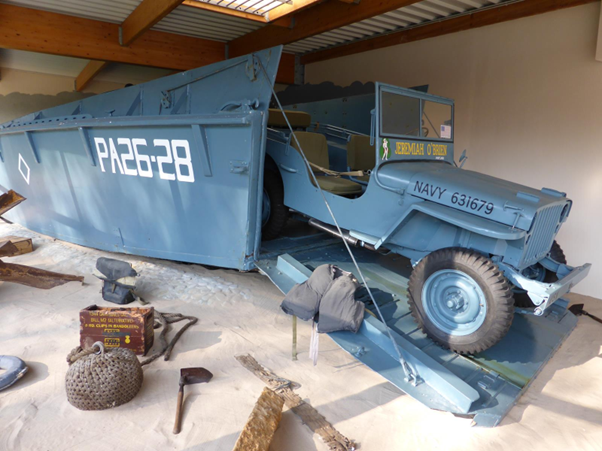
Figure 7: A landing craft, something rare to find preserved, and a US Navy jeep found inside the Omaha Beach Memorial Museum. (Omaha Beach Memorial Museum, 2026).
The landings at Gold were set at 07:25 hours due to the tide (Ford & Zaloga, 2009), and men of the XXX Corp landed on Gold with support of DD tanks and some “funnies”, including flail tanks and AVREs (Trew, 2004). The armour helped knock out some of the German defences, but were otherwise bogged down by mines and sand (Ford & Zaloga, 2009). Despite the setback, and some armour landing late due to rough seas, the beach was mostly cleared by midday and the rest of the day was spent pushing inland, dealing with German resistance, and clearing houses on the seafront (Whitmarsh, 2009). Around 1,000-1,100 casualties were sustained on Gold, with 350 confirmed killed (Trew, 2004). At Gold Beach there’s the Musée America Gold Beach, combining two museums into one building. It goes deeper into the international involvement between US Forces and the British landing that happened on the 6th.

Figure 8: British troops land on Gold Beach on D-Day. (Wikimedia Commons)

Figure 9: The entrance to the Musée America Gold Beach, which is situated in the area.
Landings on Sword also proceeded at 07:25 hours (Wilmot, 1997) with infantry, DD tanks, and engineers with AVRE support landing on the beach under heavy small arms fire (Ford and Gerrard, 2002). Despite the engineers undertaking sterling work clearing mines and obstacles, resistance was fierce and casualties raking up (Ford and Gerrard, 2002).. However, thanks to much of the armour landing safely on the beach, they were able to push up the beach and most of the beach exits had been secured by 09:30 hours (Thompson, 1968). Advancing inland, by 13:00 hours they had started linking up with paratroopers of the 6th Airborne Division at the canals mentioned yesterday (Ford and Gerrard, 2002; Fowler, 2010). 683 men were killed in the landings at Sword (Ford, 2004). At Sword Beach itself there is no dedicated museum. However, in the area there’s plenty of monuments and other museums about D-Day to visit, such as the Le Grand Bunker Musée which is about the Atlantic Sea Wall, or the Hillman Site.

Figure 10: British infantry under fire on Sword Beach. (Wikimedia Commons).

Figure 11: The front entrance to Le Grand Bunker Musee near Sword Beach, with a British 25 pounder artillery gun in front of it.
Our final beach, Juno, was led by the 7th Canadian Infantry Brigade, landing at 07:45 hours, 10 minutes later than intended due to rough seas (Stacey, 1966). The pre-landing naval bombardment and aerial bombing had largely missed the German defences, and the armour support was delayed, resulting in only the infantry landing into a storm of defensive fire (Wilmot, 1997). Later vehicle support was able to allow the infantry to move, but only after heavy casualties. By around 09:30 hours, the beach was mostly secured with 961 casualties (Beevor, 2009). There’s the dedicated Juno Beach Centre near the beach which caters to everything to do with Juno Beach, from planning to landing to securing and beyond. All sorts of artefacts, materiel and artillery pieces have be preserved in the centre, and it even tells the story of the often-forgotten disastrous Dieppe Raid of 1942.

Figure 12: Bicycle infantry of the 9th Canadian Infantry Brigade disembarking at Juno. (Wikimedia Commons).

Figure 13: A 40mm Bofors anti-aircraft gun sitting outside of the Juno Beach Centre.
With the beach landings a success, albeit with over 10,000 casualties and dozens of vehicles lost and destroyed (Whitmarsh, 2009), the landing units were able to press on and secure an area around the landing zone while tens of thousands extra men and materiel were able to be landed. Nearly 160,000 men crossed the channel and landed in France by the end of the day (Ellis et al., 2004), and the beginning of the end of Hitler’s “1,000 year Reich” had come…

Figure 14: German prisoners-of-war under guard on Juno Beach. (Wikimedia Commons).
Berengar Needham is currently a student on the MSc Museum Studies programme at the University of Leicester. This article is Part 2 of 3 - stay tuned for Part 3 tomorrow!
References
Balkoski, J (2004). Omaha Beach. US: Stackpole Books. pp. 350–352. ISBN 0-8117-0079-8.
Balkoski, J. (2005). Utah Beach: The Amphibious Landing and Airborne Operations on D-Day, June 6, 1944. Mechanicsburg, PA: Stackpole Books. ISBN 0-8117-0144-1.
Beevor, A. (2009). D-Day: The Battle for Normandy. New York; Toronto: Viking. ISBN 978-0-670-02119-2.
Ellis, L.F.; Allen, G.R.G.; Warhurst, A.E. (2004). Victory in the West, Volume I: The Battle of Normandy. History of the Second World War United Kingdom Military Series. London: Naval & Military Press. ISBN 978-1-84574-058-0.
Fletcher, D. (2006). Swimming Shermans; Sherman DD amphibious tank of World War II. Osprey Publishing. ISBN 9781841769837
Ford, K. (2004). Sword Beach. Battle Zone Normandy. Sutton Publishing. ISBN 0-7509-3019-5.
Ford, K., Gerrard, H. (2002). D-Day 1944: Sword Beach & British Airborne Landings. Vol. 3. Osprey Publishing. ISBN 0-8117-3384-X.
Ford, K., Zaloga, S. J. (2009). Overlord: The D-Day Landings. Oxford; New York: Osprey. ISBN 978-1-84603-424-4.
Fowler, W. (2010). Pegasus Bridge – Benouville, D-Day 1944. Raid. Oxford: Osprey. ISBN 978-1-84603-848-8.
Laurenceau, M. (2016). Hobart's Funnies during the Battle of Normandy. D-Day Overlord. Available at: https://www.dday-overlord.com/en/material/hobarts-funnies
Marshall, S. (1960). First Wave at Omaha Beach. The Atlantic. Available at: https://www.theatlantic.com/magazine/archive/1960/11/first-wave-at-omaha-beach/303365/
Stacey, C. P. (1966) [1960]. The Victory Campaign, 1944–1945. Official History of the Canadian Army in the Second World War. Vol. III. Ottawa: The Queen's Printer. OCLC 317692683
Thompson, R.W. (1968). D-Day, Spearhead of Invasion. New York: Ballantine
Trew, S. (2004). Gold Beach. Battle Zone Normandy. Stroud, Gloucestershire: Sutton. ISBN 0-7509-3011-X.
USACMH. (1994). Assault Plan. Omaha Beachhead. United States Army Center of Military History. Available at: https://web.archive.org/web/20120926033925/http://www.history.army.mil/books/wwii/100-11/ch2.htm
War Department. (1945). Omaha Beachhead. Historical Division, War Department, pp. 49.
Whitmarsh, A. (2009). D-Day in Photographs. Stroud: History Press. ISBN 978-0-7524-5095-7.
Wilmot, C. (1997) [1952]. The Struggle For Europe. Ware, Hertfordshire: Wordsworth Editions. ISBN 978-1-85326-677-5.


Comments