This is the end for Germany – D-Day +1 and beyond
By the end of D-Day, nearly 160,000 men crossed the channel and landed in France (Ellis et al., 2004), and the Germans had failed to follow Hitler’s orders of “throwing the Allies back into the sea” (Imperial War Museum, 2024). Despite numerous German counter attacks that day, they failed to dislodge either the landings on the beach or airborne landings of the previous night, and they never succeeded in pushing the Allies out of German-occupied France.
There’s a lot of museums that cover this topic in some way, which was the main inspiration to write these three pieces about this historic event. The D-Day Story, Army Flying Museum, Fleet Air Arm Museum, HMS Belfast, The Tank Museum, the list goes on just for English museums and all have amazing examples of original materiel or vehicles that took part in D-Day.
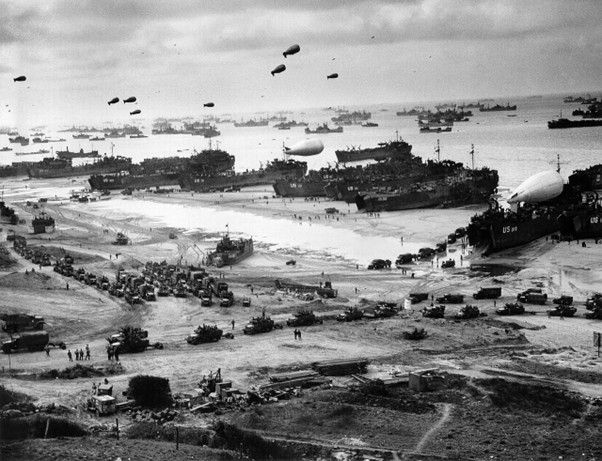
Figure 1: Allied supplies and troops landing at Omaha Beach shortly after the beaches were secured. (Wikimedia commons).
First I must bring attention to action that started on D-Day, when a group of US Army Rangers landing at Pointe du Hoc to capture a series of bunkers and machine gun posts that threatened American beach landings. Under heavy fire, the 225+ rangers landed on the beach at 07:10 hours and scaled the sheer cliff face to the top where they neutralised the nearby artillery and machine gun posts at a heavy cost over the 6th and 7th June (Beevor, 2009). Of the 225+ men, just 90 were still able to fight (Bahmanyar, 2006). While Pointe du Hoc does not have a dedicated museum near the site, there is a memorial at the top of the cliff with picturesque views and some information about what these men went through.
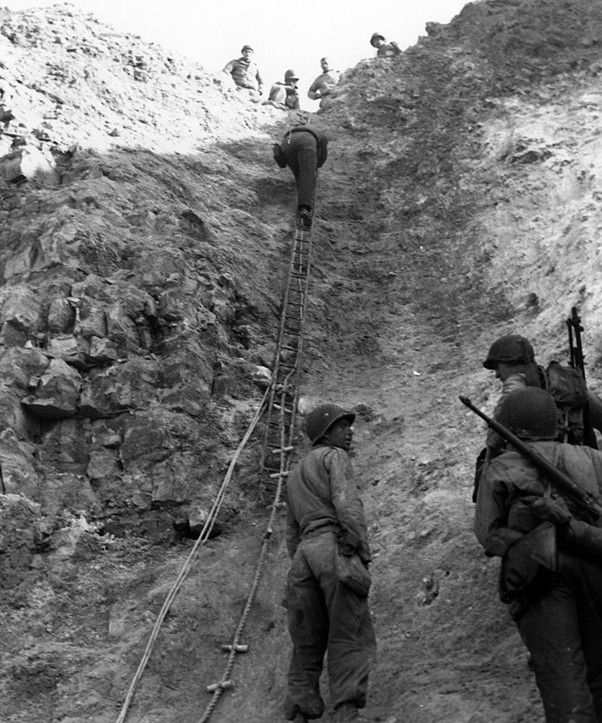
Figure 2: US Army Rangers demonstrate the ladder they used to get up to Pointe-du-Hoc. (Wikimedia commons).

Figure 3: The memorial today on top of one of the gun bunkers.
Landing on the beaches was not the only objective for the Allies on D-Day. After gaining the foothold, they were to advance inland, set up a front line, link up with most if not all paratrooper units and capture key cities all on the same day (Beevor, 2009; Churchill, 1951). However, very few of these objectives were actually achieved for various reasons. Key cities to capture included Bayeux, Caen, and Carentan, and while some units got close to these cities, they did not begin contesting them on the 6th June. Caen was not captured by British forces until the 21st July (Ford & Zaloga, 2009; Wilmot, 1997), a good month and a half after initial landings, while US Airborne forces wouldn’t secure Carentan until the 14th June (Bando, 2007). Today at Carentan there’s the Normandy Victory Museum, with guided tours, restored and working American vehicles to take rides in as well as over 30 full replica scenes in a massive museum which is definitely worth a trip to see.
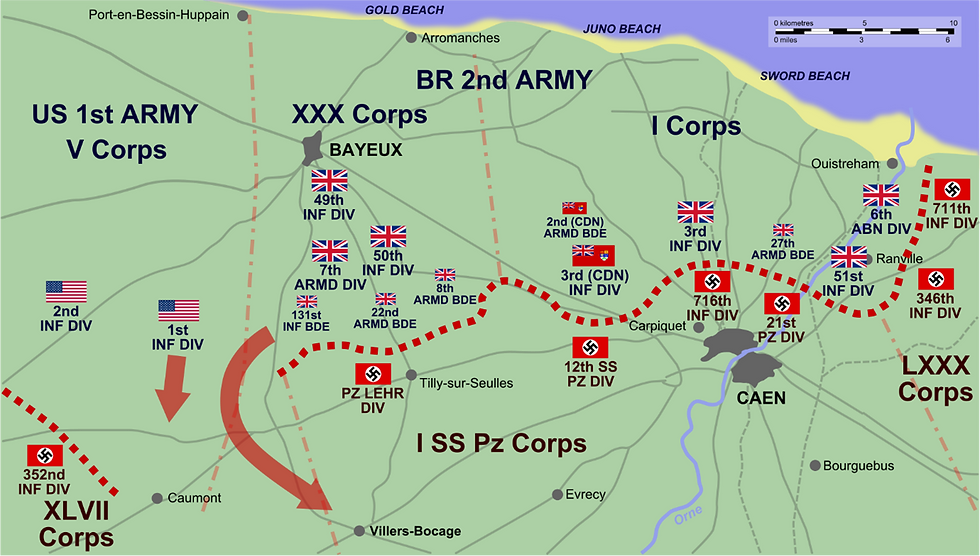
Figure 4: German and British positions on the 12th June. (Wikimedia commons).
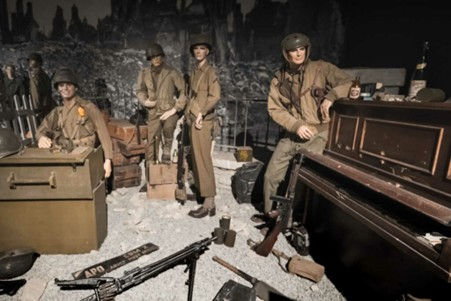
Figure 5: One of the many scenes built in the Normandy Victory Museum in Carentan.
However, good progress was made regardless in some aspects of D-Day. In some places, Allied forces advanced a good 10 kilometres inland and a few beaches were linked up in a few days (Horn, 2010), and British force from Sword Beach managed to reach the Caen canals and British airborne forces by the end of day on the 6th June as mentioned yesterday (Ford and Gerrard, 2002; Fowler, 2010). Full link up of the beaches did not happen until the 12th June, and by then the Allies had advanced up to 24 kilometres inland (Horn, 2010). The D-Day Story in Portsmouth offers good coverage of all of D-Day, and it also houses the Overlord Embroidery which is a modern day Bayeux Tapestry telling the whole story of D-Day in a beautiful medium.
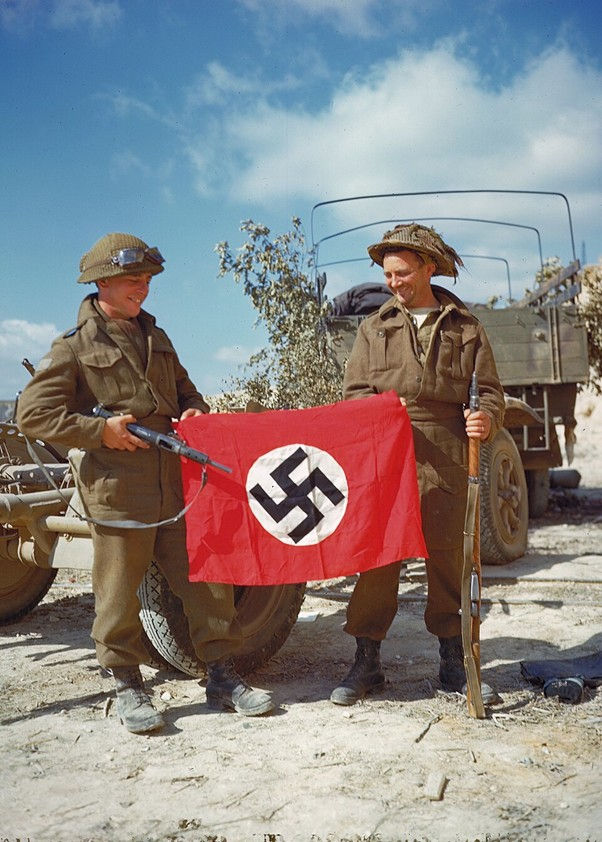
Figure 6: Some Canadian infantry with a captured Nazi flag. (Wikimedia commons).
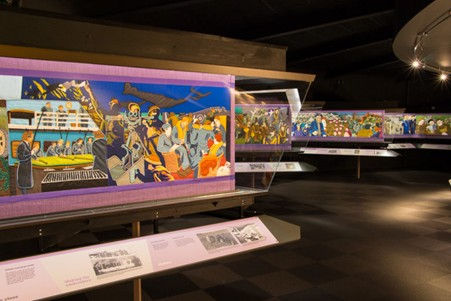
Figure 7: Part of the Overlord Embroidery at the D-Day Story, well worth a visit.
On the 7th June, the Battle of Authie occurred, which resulted in the Authie Massacre of Canadian prisoners by the 12th SS Panzer Division. The town had entered Canadian hands that day but the 12th SS dislodged them and resulted in some back-and-forth fighting, with around 100+ soldiers being encircled and executed by the division (Margolian, 1998). At the Abbey d’Ardenne, there’s a memorial for these murders soldiers, well maintained and worth visiting to pay your respects.
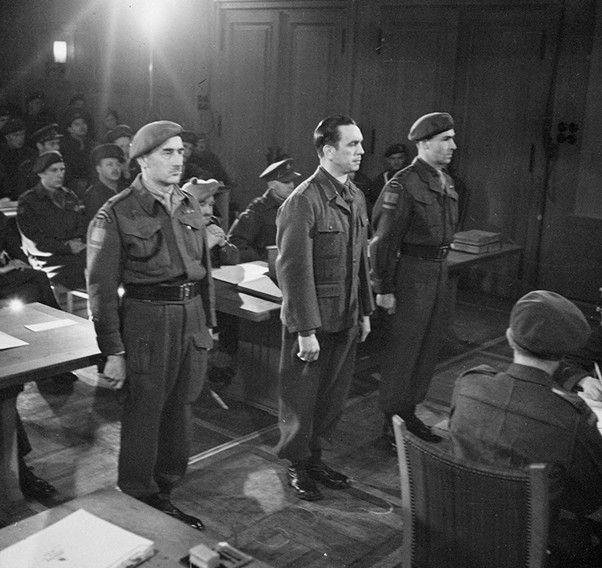
Figure 8: Kurt Meyer on trial after the war for various war crimes, including the Normandy Massacres. (Wikimedia commons).
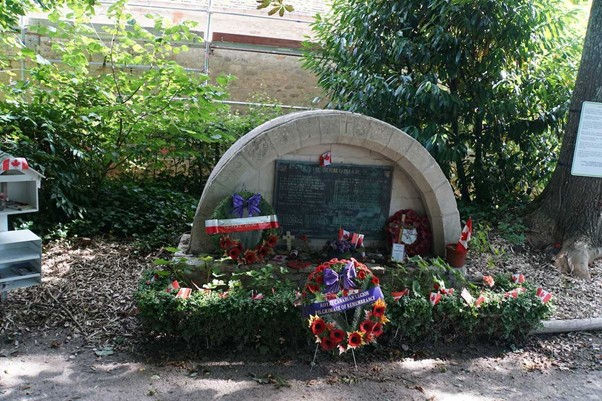
Figure 9: The memorial at the Abbey in 2017.
This battle was part of Operation Perch, a plan for British forces to surround and assault Caen. It called for British forces to capture key locations such as Carpiquet Airfield and encircle the city. Unfortunately, they encountered heavy resistance from elite German divisions that had been diverted to stop them, including the 21st Panzer and Panzer Lehr (Ellis et al., 2004). Fierce fighting at places like Carpiquet and Villers-Bocage stop the British advance and allowed the Germans to reinforce Caen, which could then only be taken with a costly prolonged siege and assault. In Caen itself there’s the Memorial de Caen museum which covers the heavy siege in detail, while the D-days Wings Museum near to Carpiquet Airfield houses a lot of restored WWII aircraft as well as gives a lot of information about the fighting that went on in and around the airfield.
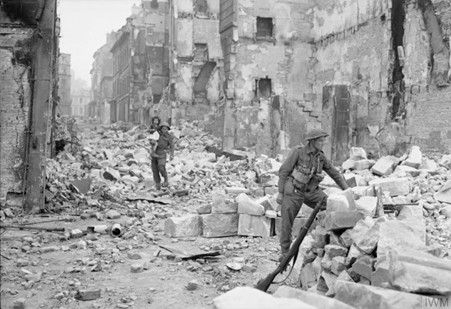
Figure 10: British soldiers in the ruins of Caen, one of whom is carrying a little girl to a safer area. (Wikimedia commons).

Figure 11: Inside one of the hangars at the D-days Wings Museum near Carpiquet Airfield.
Bayeux was captured on the 7th June, also by British forces (Chornyi, 2026), while American troops captured Carentan the subsequent week as previously mentioned, and Cherbourg was laid under siege right from D-Day, with it taking until the 1st July for the city to fall into American hands (Wilmot, 1997). Cherbourg has several museums within it, including the Musée de la Libération, telling the history of the port and its civilians during WWII.
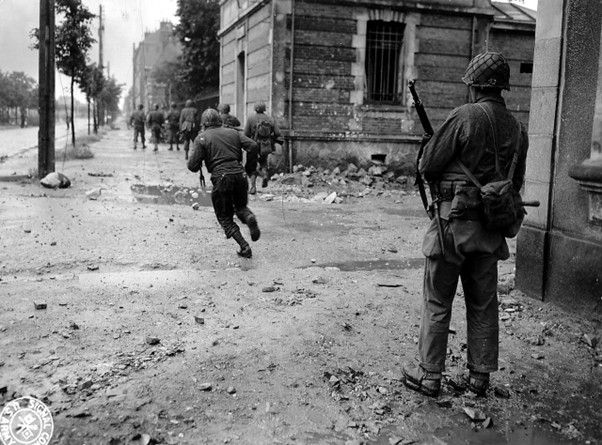
Figure 12: American soldiers advancing through the streets of Cherbourg. (Wikimedia commons).
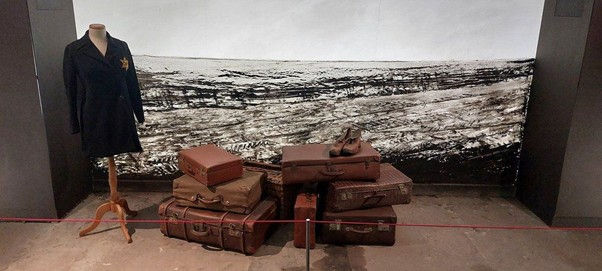
Figure 13: Civilian suitcases and clothing in the Musée de la Libération, Cherbourg.
To facilitate the mass landing, “mulberry harbours” were created on the beaches for bigger ships to dock at and bring supplies in. Premade sections of harbour were towed from England and anchored off Omaha and Gold Beach, formed from pontoons (War Office, 1943; Beevor, 2009). Omaha’s harbour was severely damaged by storms over mid-June and decommissioned, while the one at Gold Beach was used for ten months and over two million men, four million tons of supplies and half a million vehicles were landed over that time (ICE.org, 2026). Some of the harbours can still be seen today on the beach, one of the best examples of the long-lasting effect D-Day had on the world. Parts of the harbours can be seen both on the French beaches as well as areas of the UK.
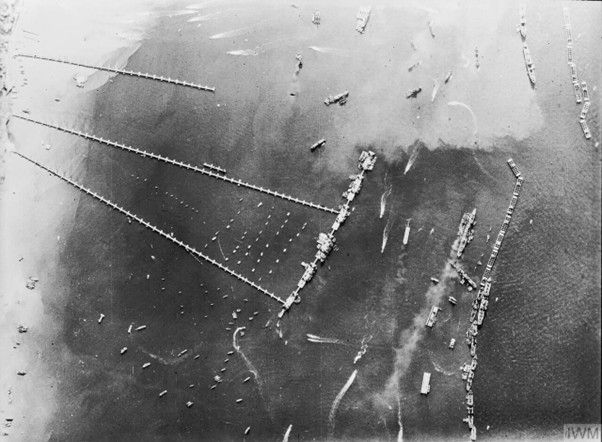
Figure 14: Mulberry harbour in October 1944. (Wikimedia commons).
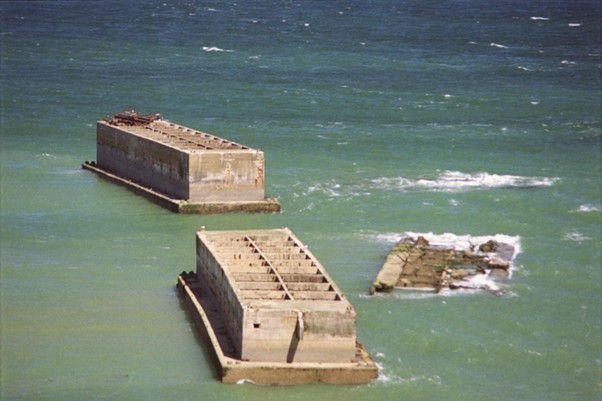
Figure 15: The remains of some of the harbour at Arromanches in 2010. (Wikimedia Commons).
D-Day is known as the largest seaborne invasion in history, but a final note for the history books on this is the planned Allied invasion of the Japanese Home Islands in Operation Downfall. Now, Downfall never happened due to the twice atomic bombings and subsequent surrender of Japanese forces, but the operation called for near 2 million men to land in several places, chiefly Kyushu and near Tokyo (MacArthur, 1950; Frank, 1999). This landing would have been far greater than D-Day (MacArthur, 1950), but due to the atomic bombings and surrender, this costly campaign thankfully never materialised. As this event never took place, there’s no dedicated museum for this. However, various Pacific Theatre museums include a section on this planned operation, including The National WWII Museum in New Orleans, which has a lot of excellent immersive exhibits, including one for the planned Operation Downfall.
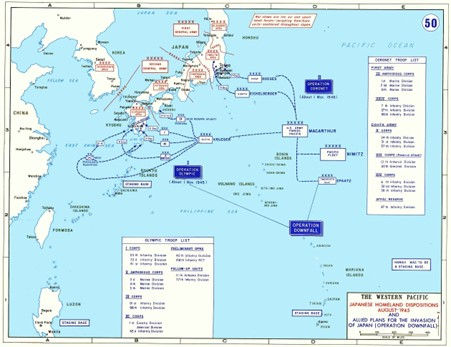
Figure 16: The plans for Operation Downfall. (Wikimedia commons).
Finally, we should all take time to reflect on this momentous event in history as it approaches its 90th and 100th anniversary. There is a lot more to D-Day that what I have talked about in these last three posts. P.L.U.T.O, for example, is another feat of engineering and ingenuity seen to support the landings. One of the pumps can be seen in the Wildheart Animal Sanctuary at Sandown, Isle of Wight. D-Day was a tremendous feat at a terrible cost, but it proved that the Nazi war machine was not invincible, not unstoppable, and that German-held shores were not impregnable. The over 10,000 Allied soldiers and 9,000+ German casualties just on D-Day itself did not die in vain, as just under a year after the invasion, Nazi high command surrendered and the war in Europe came to an end.
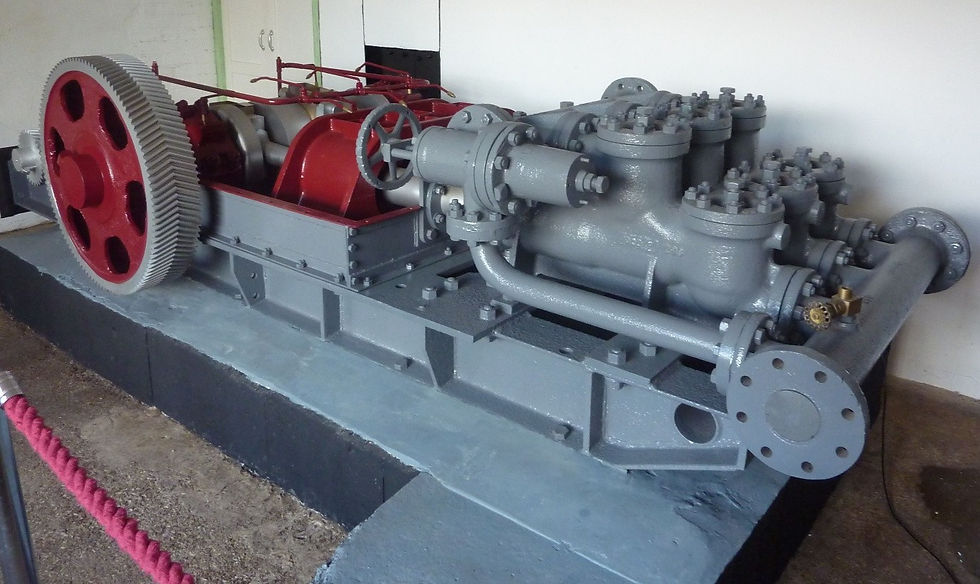
Figure 17: The restored P.L.U.T.O pump at Sandown, Isle of Wight.
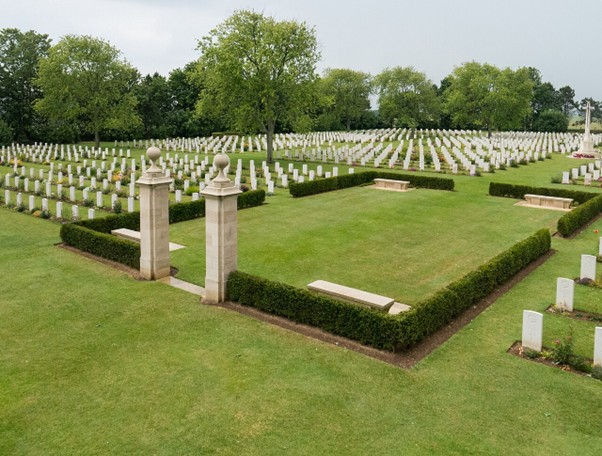
Figure 18: The war cemetery for Canadian soldiers at Bény-sur-Mer. (Wikimedia commons).
Berengar Needham is currently a student on the MSc Museum Studies programme at the University of Leicester. This article is Part 3 of 3 - we hope you have enjoyed the series!
References
Bahmanyar, M. (2006). Shadow Warriors: a History of the US Army Rangers. Osprey Publishing. pp. 48–49. ISBN 1-84603-142-7.
Bando, M. (2007). Overview of the 101st Airborne in World War II. Available at: https://web.archive.org/web/20070707052858/http://www.101airborneww2.com/unithistories.html.
Beevor, A. (2009). D-Day: The Battle for Normandy. New York; Toronto: Viking. ISBN 978-0-670-02119-2.
Chornyi, M. (2026). BAYEUX: WWII, D-DAY, DE GAULLE AND AFTER. www.war-documentary.info. Available at: https://war-documentary.info/bayeux-1940-1944/.
Churchill, W. (1951) Closing the Ring. The Second World War. Vol. V. Boston: Houghton Mifflin. OCLC 396150
Ellis, L.F.; Allen, G.R.G.; Warhurst, A.E. (2004). Victory in the West, Volume I: The Battle of Normandy. History of the Second World War United Kingdom Military Series. London: Naval & Military Press. ISBN 978-1-84574-058-0.
Frank, R. B. (1999). Downfall: The End of the Imperial Japanese Empire. New York: Random House. ISBN 978-0-679-41424-7.
Horn, B. (2010). Men of Steel: Canadian Paratroopers in Normandy, 1944. Toronto: Dundurn Press. ISBN 978-1-55488-708-8.
Imperial War Museum. (2024). The German Response to D-Day. Imperial War Museum. London. Available at: https://www.iwm.org.uk/history/the-german-response-to-d-day
Ford, K., Gerrard, H. (2002). D-Day 1944: Sword Beach & British Airborne Landings. Vol. 3. Osprey Publishing. ISBN 0-8117-3384-X.
Ford, K., Zaloga, S. J. (2009). Overlord: The D-Day Landings. Oxford; New York: Osprey. ISBN 978-1-84603-424-4.
Fowler, W. (2010). Pegasus Bridge – Benouville, D-Day 1944. Raid. Oxford: Osprey. ISBN 978-1-84603-848-8.
ICE.org. (2026). Mulberry harbours. www.ice.org.uk. Available at: https://www.ice.org.uk/what-is-civil-engineering/infrastructure-projects/mulberry-harbours.
MacArthur, D. (1950). Reports of General MacArthur: The Campaigns of MacArthur in the Pacific. Volume 1. Department of the Army. Available at: https://web.archive.org/web/20190817171601/https://history.army.mil/books/wwii/MacArthur%20Reports/MacArthur%20V1/ch13.htm.
Margolian, H. (1998). Conduct unbecoming : the story of the murder of Canadian prisoners of war in Normandy. Toronto [Ont.]: University of Toronto Press. ISBN 978-1-4426-7321-2.
Symonds, C. L. (2016). Operation Neptune : the D-Day landings and the Allied invasion of Europe (Oxford University Press paperback ed.). New York. ISBN 978-0-19-046253-6.
War Office. (1943). Artificial Harbours. War Office. Available at: https://www.mulberryharbours.com/wp-content/uploads/2014/05/1.-War-Office.-Artificial-Harbours1.pdf
Wilmot, C. (1997) [1952]. The Struggle For Europe. Ware, Hertfordshire: Wordsworth Editions. ISBN 978-1-85326-677-5.


Comments